
What happens when a simple cut doesn't heal the way it should?
For most people, wounds are a temporary inconvenience, something the body repairs naturally over time. But for millions of patients worldwide, especially those living with chronic conditions such as diabetes, healing can be slow, unpredictable, and sometimes dangerous. A minor injury can persist for weeks or months, increasing the risk of infection and complications and affecting quality of life.
Chronic and non-healing wounds remain a major clinical challenge. Traditional treatments focus on protecting the wound and preventing infection, allowing the body to heal at its own pace. But what if that process could be accelerated? What if healing could be supported in a way that works with the body, rather than relying on external devices or power sources?
This question is at the heart of the research being conducted by Prof. Neeraj Khare from the Department of Physics, Indian Institute of Technology Delhi and faculty at IIT Delhi - Abu Dhabi, together with Prof. Prashant Mishra from the Department of Biochemical Engineering and Biotechnology (DBEB), IIT Delhi, and their respective research teams.
In a recent study published in APL Electronic Devices, the research team demonstrates that a self-powered nanogenerator can convert body movement into electrical signals that enhance cell migration and accelerate wound healing.
Why do some wounds take so long to heal, and can we speed it up?
When the skin is injured, the body begins repairing itself almost immediately. But healing is not a simple or instant process, it involves a series of carefully coordinated steps that must happen in the right order.
At the center of this process is cell migration, the movement of cells such as fibroblasts and keratinocytes across the wound to repair damaged tissue.
In healthy conditions, this works efficiently. Cells are guided to the site of injury, where they help close the wound and restore the skin. In chronic wounds, however, this process is often disrupted. Poor circulation, underlying health conditions, or prolonged inflammation can slow, or even stop, healing altogether.
As Professor Khare explains, improving this natural process is key.

“The wound healing process itself depends on how the cells migrate. Our goal was to create a solution that works with the body, not against it. The question was whether we could do something to make that movement faster.”
What if the body could power its own healing?
Researchers have explored electrical stimulation as a way to improve wound healing. Applying an external electric field can enhance cell migration and support processes such as tissue regeneration. However, these approaches typically rely on batteries, wires, or external devices, making them difficult to use in everyday settings.
Professor Khare's research offers a different solution.
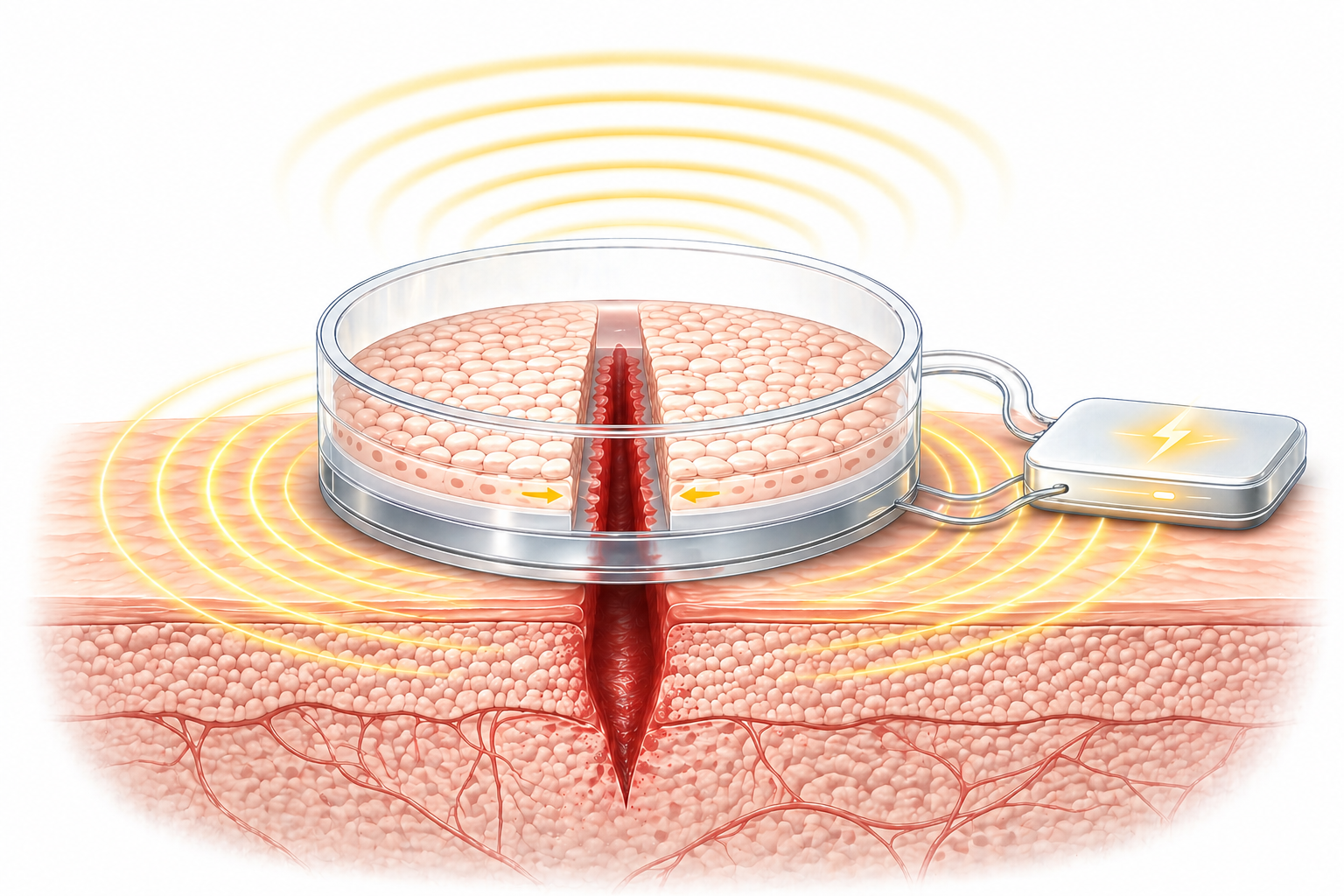
To address these challenges, his team developed a piezoelectric nanogenerator (PENG) based on DL-alanine, a biocompatible material derived from amino acids.
Instead of supplying energy from outside the body, this system generates it internally. It uses the body's own movement as a source of power, turning mechanical motion into electrical energy.
How does the device actually work?
Imagine a patient with a small wound on their hand, covered with a simple bandage. As they go about their day, typing, lifting objects, or making small, unconscious movements, that bandage is doing more than just protecting the wound. It is actively helping it heal.
At the core of this approach is a device that works like a tiny generator. When placed at the wound site, it responds to everyday movement, whether walking, stretching, or subtle hand motions. These movements create mechanical energy, which the nanogenerator converts into electrical energy through the piezoelectric effect. That energy is then delivered directly to the wound as small, localized electric fields.
These fields mimic and enhance the body's natural bioelectric signals, guiding cell migration and stimulating the healing process. In simple terms, the device strengthens what the body is already doing, making the healing process more efficient.
“What it does is convert mechanical movement into electrical energy, and that electrical energy helps enhance the wound healing process.”
In practice, the bandage itself becomes part of the treatment. As the patient moves, even slightly, it generates a small electric field that supports the movement of cells across the wound.
Unlike conventional bandages that simply protect the wound and require regular replacement, this approach allows the dressing itself to actively support healing.
This also changes the role of the patient. Movement is no longer just part of daily life, it becomes part of the treatment. Simple actions like walking or using a hand begin to contribute directly to recovery.
Because the device is made from biocompatible materials, it can be safely applied without causing toxicity or adverse effects. Extensive testing was carried out to ensure the material is fully compatible with biological tissue and safe for medical use. This means it does not interfere with natural processes or damage surrounding tissue. It also makes the device suitable for integration into practical formats such as wound dressings or bandages.
Importantly, this approach shifts the role of the patient from passive to active, turning everyday movement into a source of therapeutic energy.
What does this mean for patients, and what comes next?
The potential impact of this research is significant, especially for patients with chronic or slow-healing wounds.
Faster healing is not just a matter of convenience. It can reduce the risk of infection, shorten recovery time, and help prevent long-term complications. A solution that works without external devices or complex treatment systems could make wound care simpler and more accessible.
In laboratory studies, the nanogenerator enhanced cell migration and improved wound closure compared to untreated samples. These results are promising, but the research is still in its early stages.
Testing has so far been carried out in controlled laboratory environments using cell cultures. The next step is to move toward more realistic conditions and, ultimately, clinical trials.
“There are further steps before real-world use, Professor Khare notes. But we have demonstrated the potential of this approach.”
Looking ahead, the research also opens new possibilities. One direction involves combining DL-alanine with other materials to create hybrid systems, or heterojunctions, that could further improve performance.
At the same time, the material itself offers a practical advantage. Because it is derived from natural sources and widely available, it can be produced at scale, supporting future use in healthcare settings.
A new direction for wound healing
This research represents a shift in how wound care can be approached.
Rather than relying on external systems, it shows how the body's own mechanisms can be supported and enhanced. By converting movement into therapeutic energy, the nanogenerator provides a solution that is both simple and effective.
The result is faster healing than conventional methods, reduced risk of infection, and no need for external power.
Even small improvements in wound healing can make a meaningful difference. This approach points toward a future where treatment is not only more effective, but also more aligned with how the body naturally works.
Sometimes, the most effective solutions are the ones that work quietly in the background, helping the body do what it already knows how to do, only better.
Written by Lydia Simon | Creative Direction by Asjad Maswood